
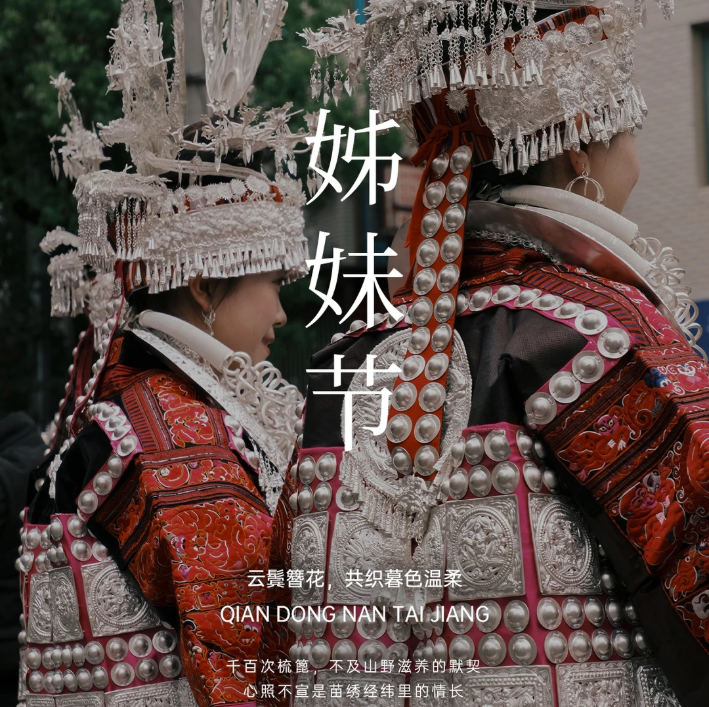
When thinking about Valentine’s Day this year, one suddenly realizes how special February 14 — the Western celebration of love — feels. Yet in the Miao villages of southeastern Guizhou, the Miao people have their own “Valentine’s Day.” It has no delicate gift boxes or roses, but it carries the fragrance of five-colored glutinous rice. It offers no blunt declarations of love, yet it resonates with melodious antiphonal love songs. This is the Miao Sisters Festival, known as “the oldest Eastern Valentine’s Day in the world,” a celebration that holds the purest and most passionate expressions of Miao love.
Unlike the minimalist romance of Western Valentine’s Day, the romance of the Sisters Festival is steeped in the warmth of daily life and ritual, passed down through generations as a cultural imprint. Celebrated in Miao communities such as Taijiang and Rongjiang in Qiandongnan Miao and Dong Autonomous Prefecture, the festival was inscribed in 2006 on China’s first list of National Intangible Cultural Heritage. In the Miao language, it is called “Nongx Ga Liang,” meaning “a feast that fulfills the sisters’ wish to reunite.” At its heart lies the sincere emotional bond between young men and women.
The romance of the festival begins with a bowl of five-colored “Sisters Rice.” As the holiday approaches, Miao girls gather natural plants such as leaves of the Chinese tallow tree and pagoda flower blossoms. They extract their juices to dye glutinous rice into black, red, yellow, green, and white. Each color carries meaning: green symbolizes the lush mountains of home; red expresses burning affection; white represents purity in love. Every grain of rice is infused with the girls’ heartfelt intentions — a delicacy for friends and family, but also a token of affection.
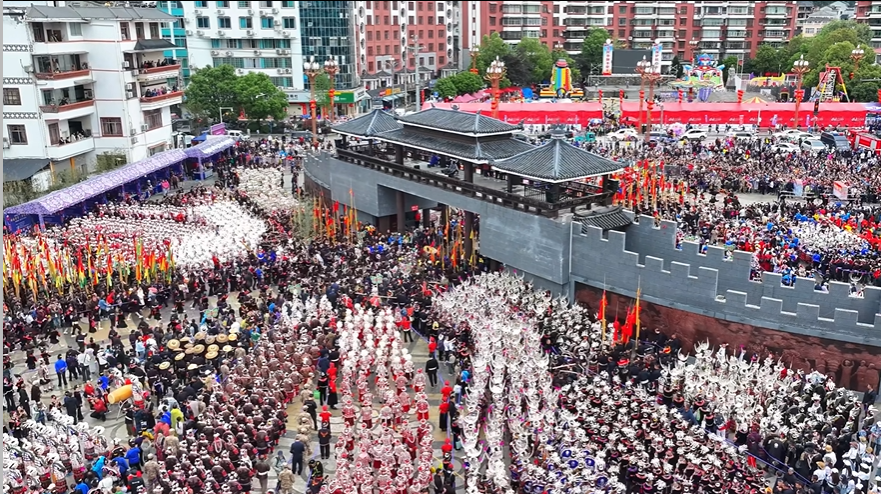
Numerous legends surround the origin of the Sisters Festival. Some say that in ancient times, Miao men often went hunting for long periods, and the young women used Sisters Rice as a pretext to invite their beloved to reunite. Others believe the festival began as a gathering for sisters separated during migrations, gradually evolving into a grand occasion for courtship. Among the most touching tales is that of Jindan and Ajiao, who defied feudal customs by secretly meeting and hiding rice in a bamboo basket. Their love eventually prevailed, and “Sisters Rice” became a symbol of faithful devotion.
On the day of the festival, romance fills the air. At dawn, young women dress in splendid embroidered attire adorned with floral and bird motifs. They wear silver crowns, earrings, and layered silver necklaces. The gentle clinking of silver ornaments in the morning light sounds like a prelude to love. Together with young men, they catch fish and splash in the fields, laughter echoing across the paddies — both festive entertainment and a subtle way to deepen mutual affection.
As night falls, the hills become a sea of romance. This is the core of the Miao “Valentine’s Day”: the antiphonal singing gathering. Young men play the wooden leaf instrument and whistle melodious tunes to invite the girls. The girls respond in song. Back and forth, feelings quietly blossom. Their lyrics praise their homeland, express tender sentiments, and test the sincerity of affection. Singing continues from sunset until moonrise. When hearts align, tokens are exchanged.

Miao courtship is never vague, yet it is filled with delicate symbolism. Girls place Sisters Rice in bamboo baskets, hiding tokens among the rice — pine needles to suggest the young man should return embroidered threads as a gift; Chinese toon sprouts to express willingness to form a lasting union; a bamboo hook to signal hope for frequent visits. If a chili pepper is hidden inside, it gently indicates that the affection is not mutual. This subtle yet eloquent expression of feeling is more moving than any spoken confession.
Today, as Western Valentine’s Day gains global popularity, the Miao Sisters Festival in Qiandongnan Miao and Dong Autonomous Prefecture continues to preserve its ancient romance. It is not only an opportunity for young love, but also a living inheritance of Miao culture. The embroidered costumes, masterful silver ornaments, lyrical love songs, and fragrant Sisters Rice all testify to the Miao people’s reverence for love and passion for life.
This Valentine’s Day, perhaps there is no need to cling to roses and candlelight. Instead, step into a Miao village in southeastern Guizhou. Watch a grand procession in full traditional dress, listen to echoing love songs, taste a spoonful of five-colored Sisters Rice, and feel a romance that has endured for centuries. Here, love is not a fleeting spark, but something rooted in tradition — a tenderness passed down through generations, hidden among green mountains and flowing waters, whispering the most beautiful Eastern love story. May we all come to understand this ancient romance, and may we each find a love that is pure and steadfast.