

Today is Lunar New Year’s Eve. In the Miao villages of Qiandongnan Miao and Dong Autonomous Prefecture, cooking smoke rises from every household, and kitchen fires burn brightly. The most touching sense of the New Year is found not only in the sound of firecrackers, but at the hearth itself — glutinous rice must be steamed, and dishes must be cooked without covering the pot. These are rules passed down orally from the elders, and cultural roots deeply engraved in the bloodline of the Miao people.
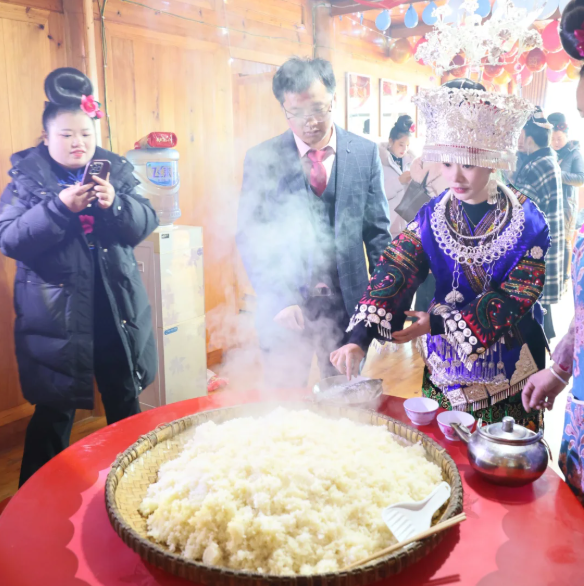
In the daily life of the Miao in southeastern Guizhou, glutinous rice has never been an ordinary staple. It is an auspicious grain that carries faith and blessings. In ancient times, after long migrations, Miao ancestors settled among the green mountains of this region. The damp and chilly climate made glutinous rice — high in calories, filling, and easy to store — the ideal food for surviving harsh winters and welcoming the New Year. Every New Year’s Eve, freshly harvested rice is soaked in clear water and steamed in wooden vats. Its fragrance fills the stilted wooden houses, offering gratitude for the year’s harvest and thanks for nature’s nourishment.
Steaming glutinous rice is the foremost ritual of Miao New Year’s Eve. The round, plump white grains symbolize completeness and smooth fortune. Some families dye the rice into five natural colors, corresponding to the Five Elements, praying for health and abundance in the coming year. As steam rises from the wooden vat, layers of sweet aroma drift through the home. The steaming rice is first offered to the ancestors, then respectfully presented to elders, and finally shared by the whole family — symbolizing blood ties and unbroken reunion. In the hearts of the Miao people, the New Year is not truly celebrated without glutinous rice; its fragrance is the most reassuring scent of the season.
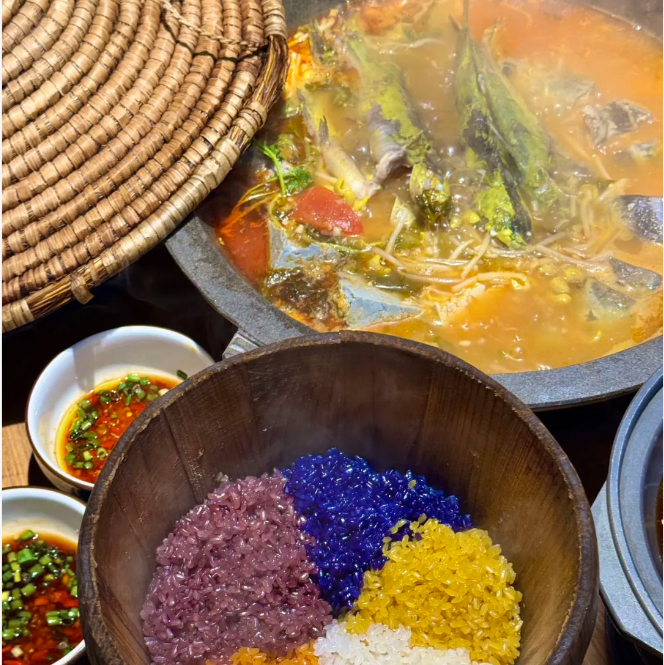
Even more distinctive is the custom of cooking without placing a lid on the pot — a tradition that carries gentle intention and ancient wisdom.
The elders used to say that New Year’s Eve is the day when ancestors return home for reunion. On this night, heaven and earth are connected, and forebears journey back from afar to share the family feast. Leaving the pot uncovered allows the aroma of food to travel farther, like a pair of warm hands guiding ancestors home. To close the lid would trap the fragrance and block the path of returning loved ones. Cooking without a lid is the most sincere welcome — a silent invitation for ancestors to come home for the New Year.
At the same time, this custom expresses hopes for the year ahead. An uncovered pot symbolizes unblocked fortune and unsealed blessings, allowing prosperity and good luck to flow into the household like rising smoke. A covered pot implies shutting good fortune outside, while open cooking signifies welcoming abundance and harmony. In times of material scarcity, having hot food constantly on the stove and a pot that was never empty represented family prosperity and freedom from hunger — the simplest and most heartfelt aspiration of the Miao people.
This tradition has been passed down through generations without written records, preserved instead by word of mouth for thousands of years. It is not a rigid rule, but a living vessel of Miao culture: carrying the resilience of migration, the virtue of honoring ancestors, and the wisdom of living in harmony with nature. Today, wood-fired stoves have been replaced by gas burners, and wooden steamers by modern pots, yet the Miao people’s devotion to their customs remains unchanged.
On New Year’s Eve, the kitchen fills with the fragrance of glutinous rice, and dishes simmer gently without lids. The scene is exactly as it was in the youth of our grandfathers and in the memories of countless ancestors. A pot of glutinous rice is the taste of reunion; an uncovered lid is a pathway for longing.
This is New Year’s Eve among the Miao of southeastern Guizhou — simple yet solemn, humble yet deeply affectionate. Within the warmth of cooking smoke lies remembrance of ancestors, blessings for family, and steadfast guardianship of cultural roots. These customs, hidden in the kitchen, have not faded with time. Instead, through generation after generation, they have grown ever warmer and more moving.
May every son and daughter of the Miao people hold fast to these traditions, remember this taste of the New Year, and let the fragrance of glutinous rice return year after year, with blessings that endure without end.